Whether you realize it or not, Linux is all around us. It is responsible for powering everything from smartphones and tablets to the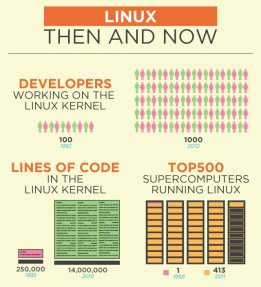 world’s most powerful supercomputers. Without it, the Internet as we know it would not exist. There would be no Google, Twitter, Facebook, or YouTube. So what exactly is it?
In its most basic definition, Linux is an Operating System (or OS), much like Windows or Mac OS. While Windows and Mac OS cost a lot of money, come with hundreds of pages of licensing terms, and are full of proprietary technology, Linux is free and open source. Sounds pretty good, right? An entire operating system, completely free. What exactly does “free and open source” mean though? Free, in this case, has two meanings. The first is the most obvious, free as in price. The end user will not pay a single penny to download and install Linux on his or her computer. The other meaning is slightly less obvious, but it is the more important; free as in “Free Speech”. This means that Linux is free to use however the end user sees fit. Unlike Mac OS or Windows which come with restrictions on the number of computers they can be installed on or the types of computers they can be installed on, Linux can be installed on an unlimited number of computers and on any type of computer the end user would like. This is the main reason people use Linux as opposed to other operating systems; it gives them complete freedom to do with it what they want. The “open source” part of Linux is also important. Open source means that anyone who wants to can download and look at the computer code that runs Linux. Additionally, anyone who wants to can change that code and redistribute it to others as a “distribution” of Linux. This is where the real power and flexibility of Linux comes into play. If you Google “linux downloads”, you’ll see about 255,000,000 results. Additionally, Linux.com has a list of over 140 different distributions, all of which specialize in running on different types of devices including desktop computers, enterprise servers, and even mobile devices like phones. All of these are possible because of the freedom Linux and other open source software allow.
So how does Linux affect our everyday life? According to w3Techs.com, Linux powers 63.9% of web servers (on the site it says Unix, the OS Linux is based off of, but they are more or less the same). That means that Linux powers the overwhelming majority of websites on the Internet. Some of the largest and most successful companies employ Linux to power their sites. Some of these include Facebook, Google, and YouTube Many government sites such as The United States Army and The White House also use Linux to power their websites. More so, Linux is the tool of choice for powering all of the equipment that goes into making the Internet work. Do you have WiFi in your home or office? Most wireless routers (responsible for making WiFi possible) use a form of Linux. On a larger scale, Linux powers many things most people don’t even think about. These include Domain Name System (DNS) servers, which are responsible for making sure when you type buckeyeinnovation.com into your browser you end up at the right website. Do you have a smartphone? Chances are it is running some form of Linux. The most prominent example of this are Android phones and tablets. Android powers 52% of US smartphones, therefore the majority of smartphone owners use Linux every day whether they realize it or not.
Why do companies and manufactures choose to use Linux? The most obvious answer is cost effectiveness. Using Linux as opposed to operating systems that cost money to install saves companies large amounts of money. In addition to this, a company using Linux does not have to pay to keep up to date with new versions of the OS. More so, however, companies choose to use Linux because of the freedom it provides. When you develop technology on top of Linux, that technology belongs to you. There are no tricky licensing agreements or additional fees to pay. That is the advantage of free and open source software.
Linux has gained popularity as the Internet has expanded, and that is a good thing for those of us who believe in the principals of open source software. This Infographic shows how Linux has grown over the last 20 years, and I definitely recommend you check it out. If you have any questions about Linux or open source technology in general, feel free to send us an email or leave a comment!